
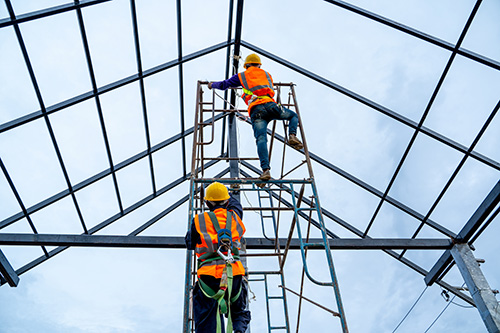
Falls, falling objects, fragile surfaces and unsuitable weather can turn a routine task into a serious incident. This guide explains the hazards and practical controls for work at height. It describes the Work at Height Regulations 2005 in Great Britain; Northern Ireland has separate equivalent regulations.
What is working at height?
Work at height involves a risk of falling to a lower level and being injured if precautions are absent. It covers many jobs and industries. Same-level slips and trips and normal use of a permanent staircase in a building are outside HSE’s work-at-height definition.
The Health and Safety Executive (HSE) defines work at height as any place where someone could fall a distance liable to cause personal injury. This includes obvious places such as roofs and ladders, but also less obvious situations such as working near holes in floors. Crucially, the actual height above the ground is not the deciding factor — even falling from ground level counts if there is a pit or opening below.
Key legal points include:
- A fall to a lower level liable to cause injury can bring a task within the work-at-height rules.
- The actual height above ground is not the deciding factor.
- Fragile surfaces such as roof lights are included.
- Working near excavations or holes counts too.
Many jobs involve working at height on a regular basis: construction workers use scaffolding, ladders and work on roofs; window cleaners work from ladders or platforms; maintenance workers fix equipment on roofs or high shelves; tree surgeons work at various heights; and warehouse staff use ladders to reach high storage. Even office workers can be working at height when changing a light bulb or accessing high filing areas. The regulations also cover temporary structures, mobile platforms such as cherry pickers, mezzanine floors and the rescue procedures needed if a worker becomes stuck or injured.
Major hazards and risks of working at height
HSE’s provisional 2025/26 figures record 31 worker deaths from falls from height in Great Britain, out of 126 worker fatalities overall — about one quarter. Falling objects, fragile surfaces and unsuitable weather also need attention when planning height work.
- 31 worker deaths from falls from height in Great Britain, provisional 2025/26 HSE figures.
- No minimum height threshold: even a low fall can require precautions where injury is foreseeable.
- Weather stop work when conditions are unsafe; follow task-specific and manufacturer limits.
Falls can occur from ladders, scaffolds, roofs and platforms or into openings. Low-level falls can also cause serious harm. Identify unprotected edges, unsuitable surfaces and defective equipment, and choose controls before anyone is exposed. Do not assume a familiar task or a short visit is safe.
Falling objects can injure people below and nearby. Secure tools and materials and consider suitable toe boards, containment, lifting arrangements and exclusion zones. Take account of wind and the route an object could take. Head protection is not a substitute for preventing objects falling or keeping people out of danger.
Fragile surfaces include rooflights, non-reinforced fibre-cement sheets, corroded metal and deteriorated boards. Fragility may not be obvious from appearance. Treat roofs as fragile unless a competent person confirms otherwise, and identify openings or areas concealed by debris or coverings before choosing access and protection.
Weather can affect grip, visibility and equipment stability. Assess wind, rain, ice, storms and temperature for the task, apply manufacturer operating limits and stop when conditions compromise safety. There is no single 40km/h wind limit that makes all ladder or platform work safe below it.
Risk assessment and risk management
Risk assessment identifies potential hazards at height, while risk management implements control measures to reduce those dangers. A systematic approach keeps workers safe through proper hazard identification and continuous monitoring.
Assess the task, access route, fall hazards, people at risk, equipment and rescue needs. The detail should match the risk. A generic assessment may support repeated work only if it fits the actual conditions; review it when circumstances change or controls may no longer work. Employers with five or more employees must record significant findings.
Hazards can be grouped into clear categories:
- Fall hazards — unprotected edges, holes, fragile roofs.
- Equipment hazards — faulty ladders, inadequate scaffolding.
- Environmental hazards — wind, rain, poor lighting.
- Human factors — fatigue, inadequate training, rushing.
Follow the hierarchy: avoid work at height where reasonably practicable, prevent falls where height work remains, then minimise remaining fall distance and consequences. At each stage prioritise collective protection over personal protection.
| Step | Approach | Examples |
|---|---|---|
| 1. Eliminate | Avoid work at height entirely | Work from ground level using extended tools |
| 2. Prevent | Stop falls occurring | Install guardrails, use scaffolding systems |
| 3. Minimise | Reduce remaining fall distance and consequences | Safety nets, fall arrest systems, reduced fall distances |
Regular monitoring ensures control measures remain effective. Equipment inspections, worker feedback and incident analysis identify when improvements are needed, and competent persons should supervise high-risk activities to verify safety procedures are followed correctly.
Fall prevention and control measures
The most effective approach follows a clear hierarchy of protective measures. Workers can be protected through elimination of height work, physical barriers, and systems that catch or arrest falls.
Eliminating the need to work at height provides the highest level of protection. Workers can use extendable tools from ground level instead of climbing, install cables and equipment at ground level, and design lighting masts and similar structures to lower for maintenance. Pre-fabrication allows complex work to happen at ground level before components are raised and installed with mechanical lifting equipment.
Guardrails and edge protection prevent falls when correctly designed and installed. For construction work, top guardrails must be at least 950mm high, with unprotected gaps no greater than 470mm and suitable toe boards. Different requirements can apply to buildings, machinery and other non-construction settings; a 150mm toe board is not a universal legal specification.
Safety nets and soft landing systems can reduce remaining fall distance and consequences. Install nets as close as possible to the working level, with sufficient clearance below for deflection. Competent people must design the arrangements, install and inspect the system, and plan rescue. Follow the system’s requirements rather than applying a universal six-metre rule.
Personal protective equipment and fall protection systems
Protective equipment must suit the task and work together as a system. Harnesses and lanyards are used where the selected personal protection requires them; they are not automatically needed on every fully guarded platform.
Select suitable, compatible equipment with the required conformity information and instructions. Check it before use and arrange maintenance and competent inspections appropriate to the equipment and conditions. Remove damaged or suspect equipment from service, report defects and follow manufacturer instructions for cleaning, storage and retirement.
Harnesses and lanyards. A fall-arrest system requires a suitable full-body harness and compatible connecting equipment. Fit and adjust it exactly as instructed by the manufacturer. Restraint and fall-arrest lanyards have different purposes; do not substitute one without a competent assessment of the complete system.
Fall restraint prevents the user reaching a position from which they could fall. Fall arrest stops a fall after it begins and requires suitable anchorages, adequate clearance, control of swing-fall risks and planned rescue. Anchorage strength depends on the system and design; 15kN is not a universal minimum for every application. Check all accessible edges and fragile areas when designing restraint.
Head protection. Select a helmet for the assessed hazards and how it will be used with other equipment. Follow the manufacturer’s fitting, retention, inspection and replacement instructions. An EN 397 marking alone does not establish suitability for every side impact or fall-at-height scenario, and there is no universal three-to-five-year replacement interval for all helmets.
Equipment and access platforms
Proper equipment selection reduces fall risks and provides stable work surfaces. Each type of access equipment serves a different purpose and needs specific safety measures.
Scaffolds and towers need competent erection, safe access, suitable platforms and protection against falls. Mobile towers must follow their manufacturer’s assembly method, such as advance guardrail or through-the-trap where specified; tower stabiliser and platform arrangements are not universal rules for every scaffold. Inspect before use and after events affecting safety. Construction platforms with a possible fall of 2m or more also need inspections at intervals not exceeding seven days.
MEWPs need suitable ground, clear working space, safe loading and protection against overturning, entrapment and collisions. Operators need relevant training and familiarisation with the model. Where required, use a suitable short restraint system attached to the manufacturer-provided anchorage. Do not treat fall arrest as permission to climb out of a basket; transfer at height is not normally recommended and needs a specifically assessed method.
Cherry pickers and scissor lifts have different operating limits. Follow the manufacturer’s instructions for stabilisers, loading, travel and weather. Establish daily checks, maintenance and a rescue plan, including someone who can operate the ground controls. MEWPs require a competent thorough examination every six months or in accordance with a competent person’s examination scheme.
Training, competence and regulatory compliance
Proper training and regulatory compliance form the foundation of safe working at height. The Work at Height Regulations 2005 establish clear legal duties for employers, while competence standards ensure workers have the skills to operate safely.
Competence means having the skills, knowledge and experience for the task, or training under competent supervision. Match instruction and practical training to the equipment and work. Specialist tasks need specialist competence; no single online certificate, apprenticeship or standard is a universal qualification for all work at height.
Employers and others controlling height work have duties according to their responsibilities and control. Assess risks, apply the hierarchy, select suitable equipment and arrange supervision and rescue. HSE or the relevant local authority enforces workplace health and safety in Great Britain; Northern Ireland has its own legislation and enforcement arrangements.
Keep equipment safe through checks, appropriate recorded inspections and maintenance. Frequencies depend on the type of equipment, conditions, instructions and applicable rules. Act on defects and worker feedback. Records help manage these duties but do not themselves prove that the work is safe or compliant.
Sources & references
- HSE — Fatal injuries in Great Britain, provisional 2025/26; Work at Height Regulations 2005, as amended (Great Britain); HSENI — Working at height and Northern Ireland legislation
- HSE — Definitions, guardrails, ladders and competence; HSE — Avoid, prevent and minimise: step-by-step guide; HSE — Working at height: a brief guide (INDG401); HSE — Risk assessment, recording and review
- HSE — Scaffold design, guardrails and inspections; HSE — Mobile elevating work platforms; HSE — Safety nets and soft landing systems
- HSE — Personal protective equipment at work (L25); HSE — Construction work at height: harness inspections; HSE — Enforcement, notices and penalties
- HSE — scaffold inspection and reports
Make sure everyone who works at height is properly trained and competent.
Train your team to work safely at height →
Mark writes about working at height, workplace safety, compliance and accredited training for Working at Heights Course, part of Online CPD Academy.