
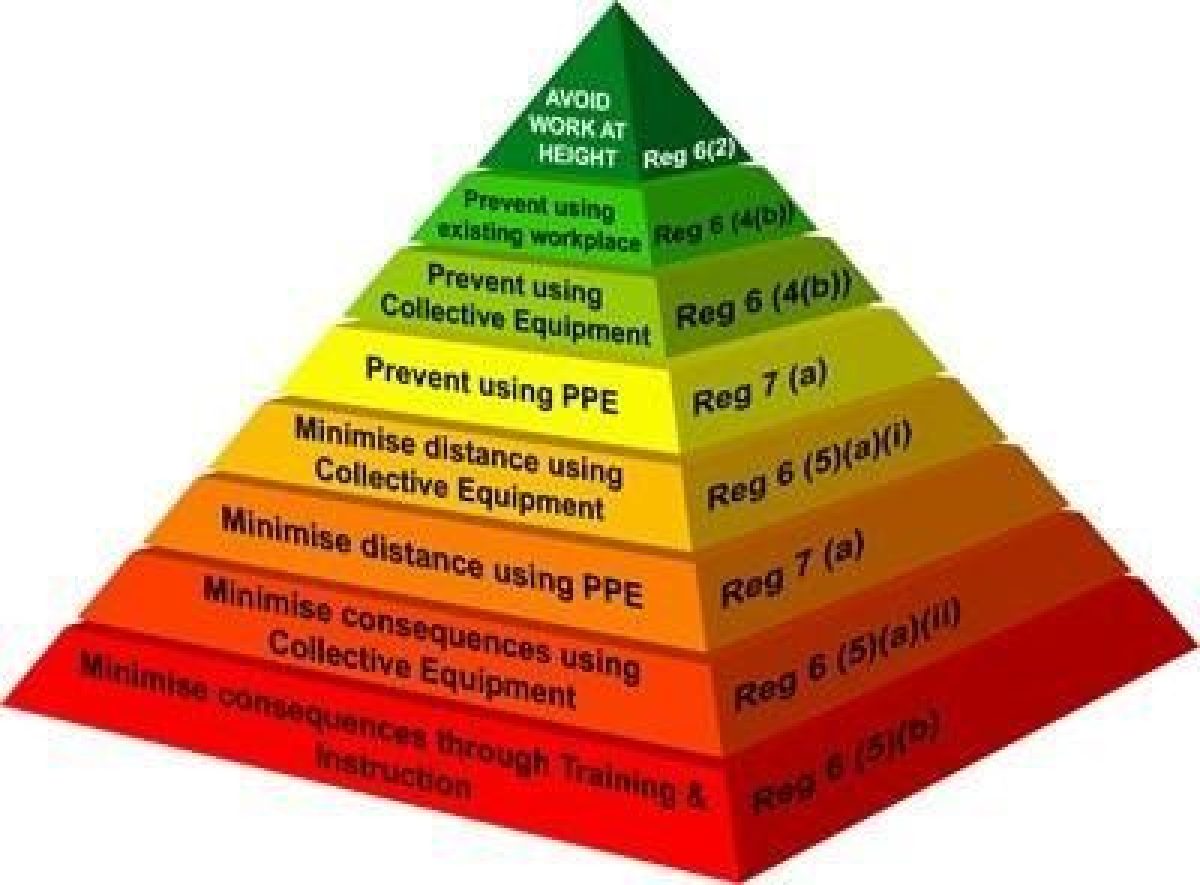
Planning work where someone could fall to a lower level means following the work at height hierarchy: avoid the work at height where reasonably practicable, prevent falls where it remains, then minimise remaining fall distance and consequences. At each stage give collective protection priority over personal protection. This guide explains how to apply those principles when choosing equipment and organising work.
Understanding the working at height hierarchy
Working at height includes work above ground, through a fragile surface or near an opening where a fall to a lower level could cause injury. It applies across industries, including low-level tasks. HSE excludes same-level slips and trips and normal use of a permanent staircase in a building from this definition.
The hierarchy of control gives you a systematic way to manage that risk. It runs through three guiding principles, applied in order:
- Avoid working at height wherever it is reasonably practicable.
- Prevent falls from occurring where the work cannot be avoided.
- Minimise the distance and consequences of a fall if a residual risk remains.
Avoid, prevent and minimise are the three stages of the work at height hierarchy. The five practical sections below explain design choices, equipment, management and personal systems; they are not five separate statutory stages. Training and supervision support every stage rather than replacing physical protection.
The Work at Height Regulations 2005 apply in Great Britain; Northern Ireland has separate equivalent regulations. Employers and those controlling the work must assess risks, plan and supervise it, and use competent people and suitable equipment. Planning includes emergencies and rescue. Responsibilities depend on the work and the extent of each duty holder’s control.
1. Avoid work at height through design
First ask whether the task can be done from a place without the fall exposure. Moving maintenance to ground level or changing the design can remove that part of the risk. Assess any risks introduced by the alternative method as well.
Building design offers elimination opportunities at the planning stage: services can be positioned at accessible heights, roof-mounted plant relocated to ground level, and access requirements considered before construction begins. Useful questions to ask include: can the task be done differently? Can equipment be moved to ground level? Can remote technology replace physical access? Are there alternative methods available?
Task redesign changes how work is done rather than where. Extending and telescopic tools let workers reach elevated areas from the ground; components can be assembled at ground level before installation; and modular or pre-fabricated systems cut the amount of height work during construction. Real-world examples include lowerable light fittings that bring lamp changes to ground level, water-fed pole systems for cleaning windows from below, ground-level cable installation, telescopic masts for antenna work, and crane-assisted positioning of pre-assembled components.
2. Choose access that prevents falls
Where height work remains, consider an existing safe place before choosing access equipment. A guarded platform, scaffold or suitable MEWP can provide collective protection. Select equipment for the job and its surroundings; no equipment type is automatically the safest for every task.
Compare the working position, duration, loads, ground conditions, overhead hazards and access needed. A MEWP may be suitable for one task and a scaffold for another. Ladders remain an option where the risk assessment justifies them under HSE’s criteria.
Ground-based inspection or maintenance methods may remove the need for access at height. Check that any proposed alternative can achieve the task safely and assess its other risks. Workers need appropriate instruction and competence for the method selected.
3. Use suitable collective protection
Guardrails and guarded platforms prevent falls. Safety nets and soft landing systems provide collective mitigation when a fall risk remains; they do not prevent a fall. A net’s need for correct installation does not make it personal protection. Plan safe installation, use and removal for every system.
For construction work, top guardrails must be at least 950mm high, with no unprotected gap greater than 470mm and suitable toe boards. Scaffold decks must suit the work and loads. Non-construction settings have different applicable requirements; there is no universal 150mm toe board, 600mm platform or 0.74kN design specification for all height work.
Select equipment for the working height, task duration, loading, ground and weather conditions. Follow manufacturer limits and account for workers, tools and materials. Identify overhead electricity hazards and establish safe controls; choosing non-conductive equipment alone does not make work near power lines safe.
Keep equipment safe through pre-use checks, maintenance and competent inspections. Construction platforms from which someone could fall 2m or more require inspection after assembly, after events affecting stability and at intervals not exceeding seven days. MEWPs need thorough examination every six months or under a competent person’s examination scheme. Keep inspection, maintenance and thorough-examination arrangements distinct and act promptly on defects.
4. Plan, supervise and communicate
Plan the work, access, inspections, weather precautions, communication and rescue before starting. Coordinate with other people affected by the task. Supervision must be appropriate to the risks, complexity and workers’ competence; the general height rules do not require continuous supervision by a specially qualified supervisor for every simple task.
Assess the actual task and conditions. Employers with five or more employees must record significant findings. A suitable existing assessment can cover repeated work if it remains applicable; review it when controls may be ineffective or circumstances change. A method statement can help explain complex or higher-risk work, but is not a universal separate document for every height task.
Provide task-specific instruction and training, including equipment use and emergency arrangements. People must be competent for their work or, while training, supervised by someone competent. A certificate is useful evidence of training, not proof that a person can safely perform every height task. Review training needs when equipment, duties or capability change.
5. Select and manage personal protection
Personal work restraint belongs in fall prevention: it stops the wearer reaching a fall position. Personal fall arrest limits a fall that can still occur. Give collective protection priority within each stage and consider prevention before mitigation. Safety nets are collective equipment, not PPE. Helmets and other PPE must be selected for the hazards they address.
Use a compatible system designed for the work, with suitable anchorages and the manufacturer’s fitting and connection instructions. For fall arrest, calculate clearance, allow for system deployment and consider swing falls and rescue. There is no single 15kN anchor rule for all systems. Transferring between anchorages needs a planned method that maintains the required protection.
Check personal fall-protection equipment before use and arrange recorded detailed inspections appropriate to its use and manufacturer guidance. HSE recommends harness inspections at least every six months, more often in arduous use. Remove suspect equipment and equipment that has arrested a fall from service for competent assessment and follow the manufacturer’s retirement instructions. Plan prompt rescue before relying on fall arrest.
Sources & references
- HSE — Avoid, prevent and minimise: step-by-step guide; Work at Height Regulations 2005, as amended (Great Britain); HSENI — Working at height and Northern Ireland legislation
- HSE — Definitions, guardrails, ladders and competence; HSE — Working at height: a brief guide (INDG401); HSE — Risk assessment, recording and review
- HSE — Scaffold design, guardrails and inspections; HSE — Mobile elevating work platforms; HSE — Safety nets and soft landing systems
- HSE — Construction work at height: harness inspections; HSE — Personal protective equipment at work (L25)
- HSE — scaffold inspection and reports
Make sure everyone who works at height understands the hierarchy of control.
Train your team to work safely at height →
Mark writes about working at height, workplace health and safety, compliance and accredited training for Working at Heights Course, part of Online CPD Academy.